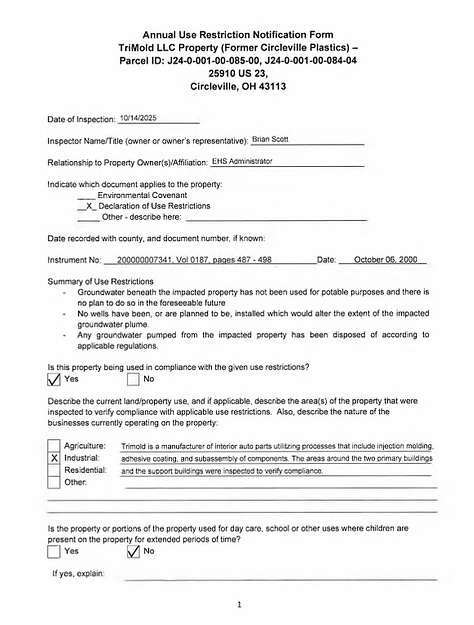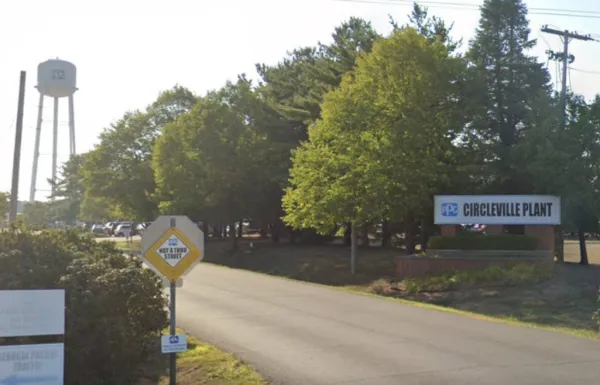
PPG Industries has operated a manufacturing facility at 559 Pittsburgh Road in Circleville for decades. Beneath that facility, and spreading west toward the Scioto River, sits a plume of 1,4-dioxane — a synthetic industrial chemical the EPA classifies as a probable human carcinogen. The plume has been there since at least August 1998. That is the earliest data in the monitoring records. Nobody knows how long it was there before anyone started looking.
This is not a secret. Ohio EPA knows about it. PPG knows about it. The monitoring has been ongoing for 27 years. The documents are public record.
What is not being talked about is what those documents actually show.
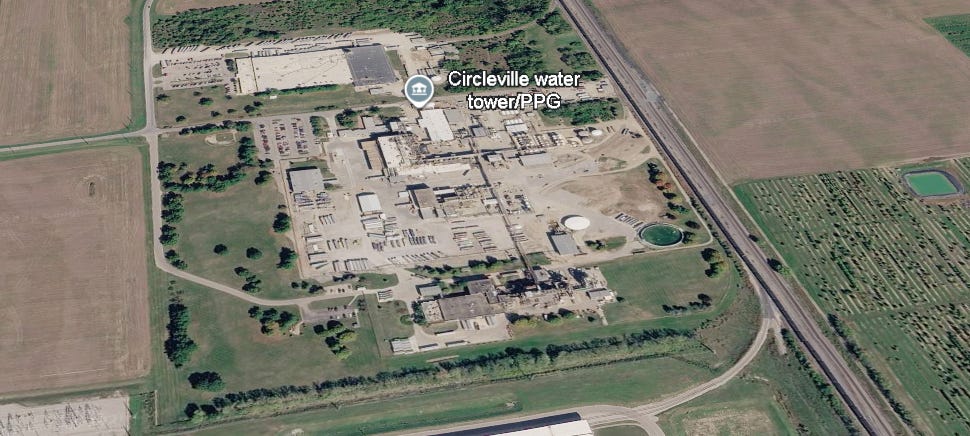
The contamination is not going away.
The cleanup standard for 1,4-dioxane in Ohio groundwater is 4.6 micrograms per liter. The Ohio EPA tightened that standard in 2018 after updated toxicity data showed the chemical was more dangerous than previously understood.
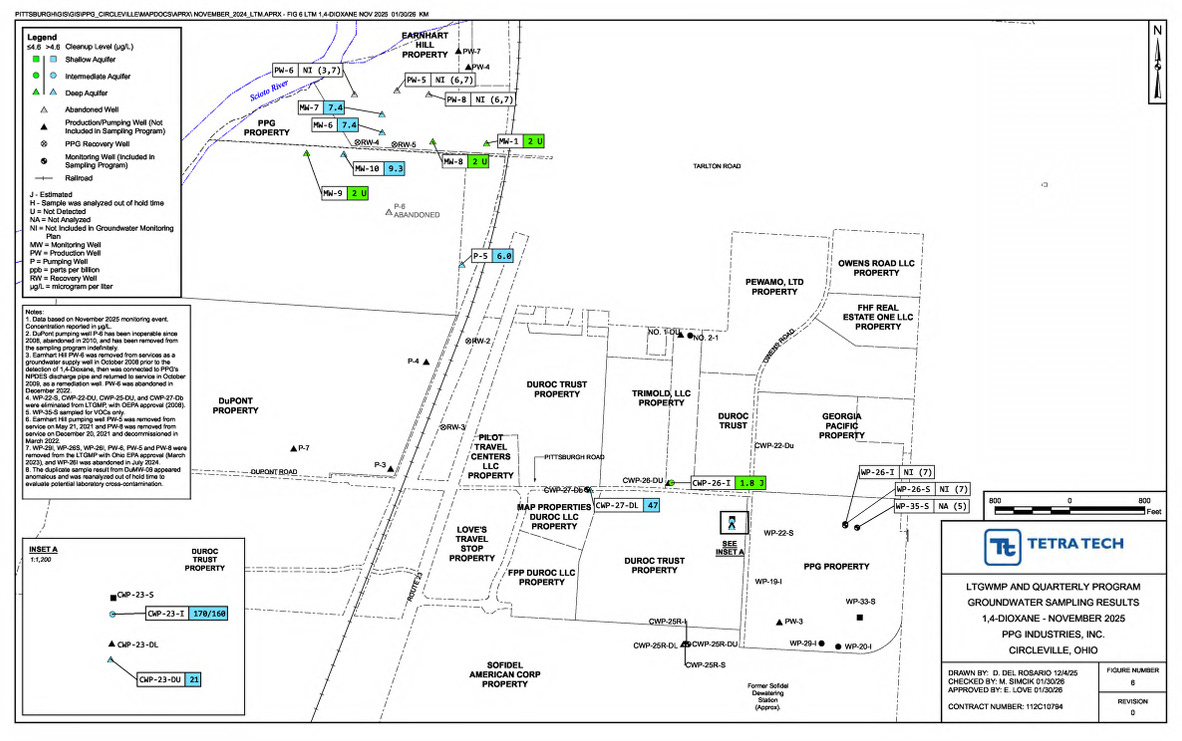
As of November 2025 — the most recent monitoring event, the 48th in this program’s history — the center of the PPG plume measured 170 µg/L. That is 37 times the cleanup standard. The well has been above cleanup levels continuously since monitoring began in 1998. The historical high was 530 µg/L in April 1999. Nearly three decades of pumping and monitoring, and the center of the plume is still 37 times what the Ohio EPA considers safe.
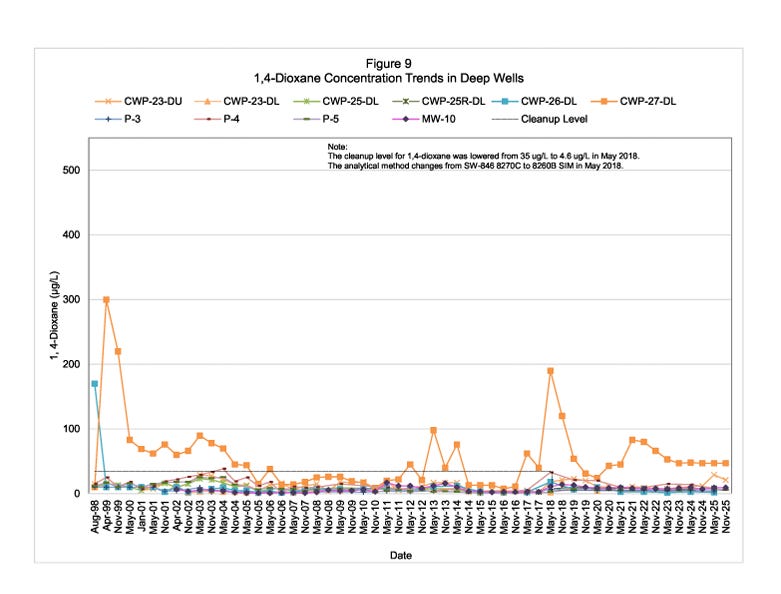
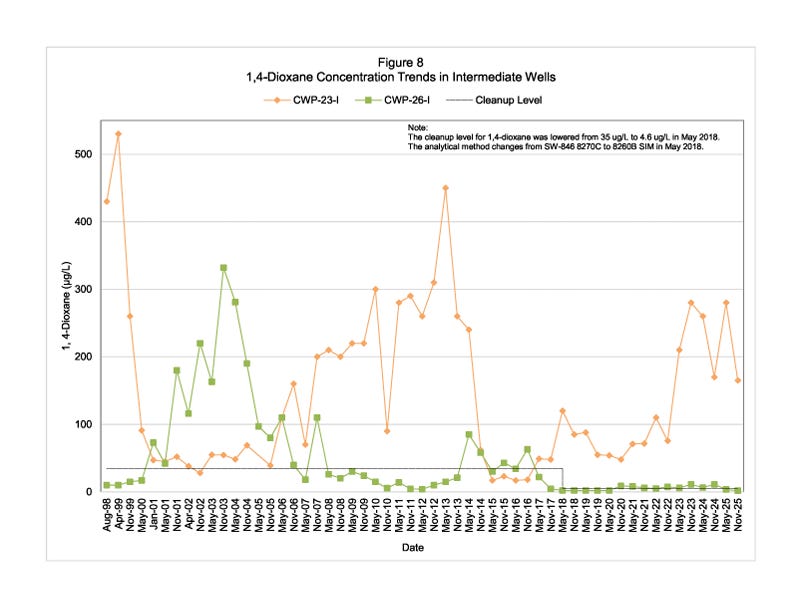
Moving westward toward the Scioto River, contamination at well CWP-27-DL measured 47 µg/L — more than ten times the cleanup standard. Well CWP-23-DU measured 21 µg/L. The plume is not retreating. It is being managed — and there is a significant difference between those two things.
PPG is discharging contaminated water directly into the Scioto River. Every month.
This is the part of the documents that nobody is talking about.
PPG operates recovery wells that pump contaminated groundwater from the plume. That water is then discharged into the Scioto River under a National Pollutant Discharge Elimination System permit. The monthly discharge sampling data in the monitoring report show 1,4-dioxane concentrations in PPG’s discharge to the Scioto River ranging from 8.0 µg/L to 12.0 µg/L every single month from June through November 2025.
The cleanup standard is 4.6 µg/L.
PPG is discharging water into the Scioto River at concentrations between one and a half and two and a half times the level Ohio EPA considers safe for groundwater — month after month, directly into a river that runs through Pickaway County and across southern Ohio.
The permit allows it. That does not mean it is safe. It means someone decided it was acceptable.
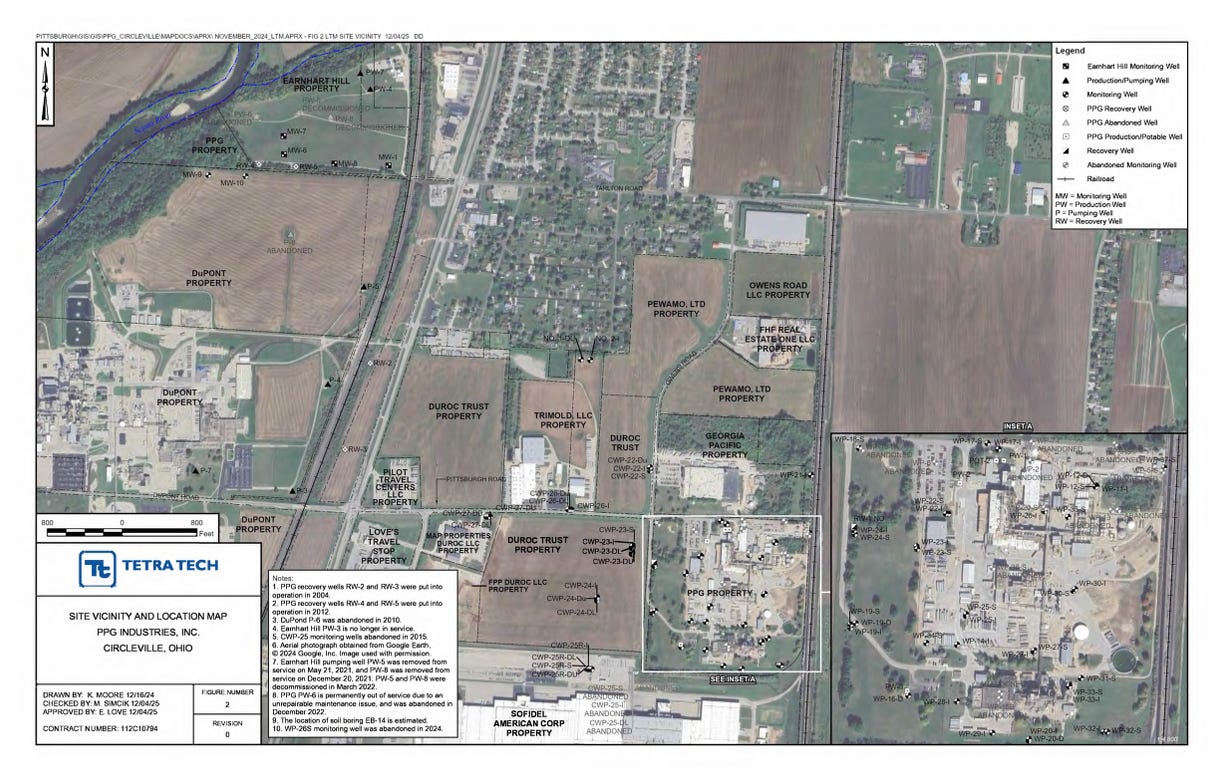
The contamination near drinking water sources.
The Earnhart Hill Regional Water and Sewer District operates a wellfield that serves area residents. Two monitoring wells inside the boundary of that wellfield — MW-6 and MW-7 — both measured 7.4 µg/L in November 2025.
Previous EPA documents show that Earnhart Hill discontinued use of supply well PW-6 in October 2008 after 1,4-dioxane was detected at the site. PPG then provided financial support for the purchase of Richard's Wellfield in exchange for Earnhart Hill decommissioning water supply production wells PW-5 and PW-8, which were removed from service in 2021 and permanently decommissioned in March 2022. Replacement wells PW-9 and PW-10 were installed in the Richard's Wellfield, away from the contamination plume.
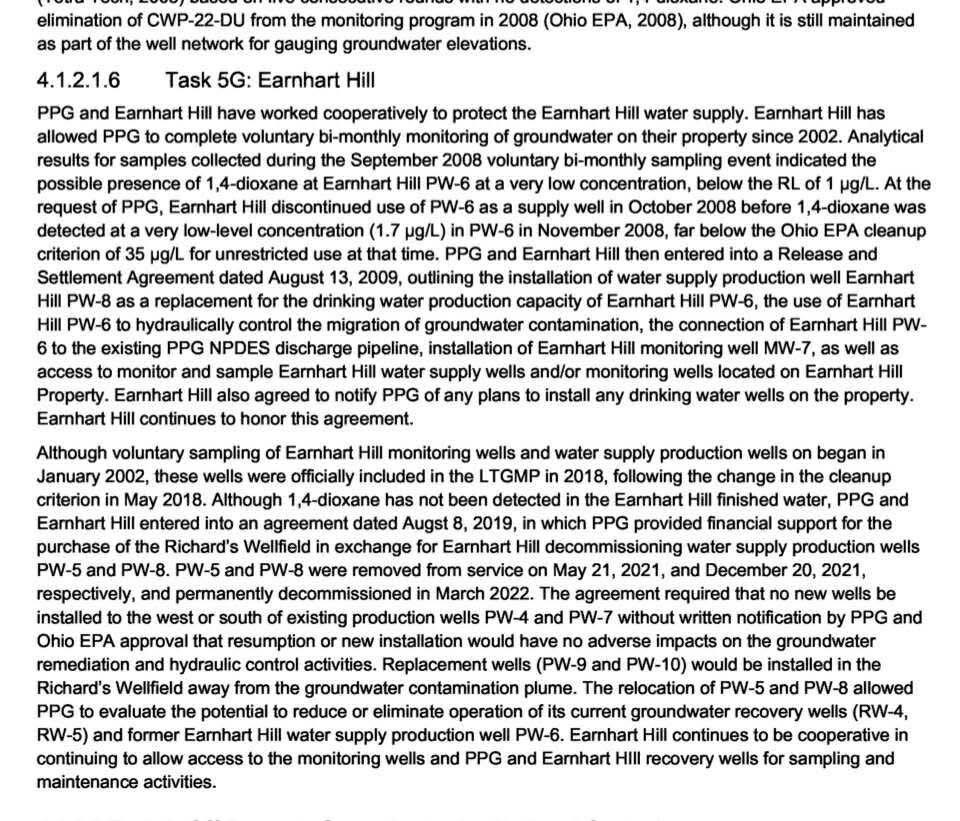
When PPG took its recovery wells offline for a pilot study between February 2023 and May 2024 to evaluate natural groundwater flow conditions, the 1,4-dioxane concentrations in the Earnhart Hill wells immediately increased above the cleanup standard. PPG had to restart the recovery wells specifically to prevent the plume from advancing further into the drinking water zone. The company does not dispute this. It is in their own monitoring report.
PPG’s recovery wells stand between the plume and a regional drinking water source. Those wells depend on continuous operation, continuous power, and continuous maintenance. In October 2025, an electrical power surge took them offline for nine days.
Nine days.
The health risk assessment PPG submitted is inadequate — and Ohio EPA has said so in writing.
In May 2026, the Ohio EPA issued formal written comments on the risk assessment protocol PPG submitted for the facility. The agency identified five specific problems.
PPG was using a toxicity database specific to Ohio’s Voluntary Action Program — not the appropriate database for this type of assessment. It was not using the most current federal toxicity values for arsenic from the EPA’s Integrated Risk Information System. It was using site-specific upset emission factors for kiln operations rather than applying the more conservative federal default factors as required by guidance. It was modeling residential exposure over 26 years when federal guidance recommends also modeling at 30, 60, and 100 years for an existing facility expected to continue operating. And it was using general population fish consumption rates rather than the higher default rates appropriate for people who regularly fish, which in a community along the Scioto River is not a hypothetical population.
Every single one of those corrections, if applied, would make the health risk from this facility look worse than PPG’s assessment currently shows. The Ohio EPA has required PPG to redo the assessment, incorporating those corrections within 45 days.
What 27 years of monitoring have produced
The 48th monitoring report was submitted in February 2026. The Ohio EPA approved it in March 2026. The plume is still there. The discharge to the Scioto River continues. Portions of the Earnhart Hill wellfield near PPG remain above the cleanup standard. The risk assessment is being redone because the original methodology was inadequate. And the people living near this facility, fishing the Scioto and drinking water in this region, have not been told any of this in plain language.